Multi-substrate input
Natively processes DNA, RNA, and protein sequences. Protein inputs are reverse-mapped to nucleotides via an integrated tblastn search against NCBI.
DNARNAProtein → nt
A high-performance toolkit for tracing microRNA binding across DNA, RNA, and protein targets — with thermodynamic scoring, AU-context evaluation, and confidence-graded results in a single command.
Six tightly-scoped capabilities, no glue code. Drop a target sequence in, get classified interactions back.
Natively processes DNA, RNA, and protein sequences. Protein inputs are reverse-mapped to nucleotides via an integrated tblastn search against NCBI.
Toggle between canonical exact seeds and a flexible wobble-pair search with re-weighted biological confidence.
Powered by ViennaRNA's RNAduplex to compute minimum free energy (MFE) of every candidate duplex.
Every hit is graded — Very High, High, Medium, Low — using MFE, motif identity, AU context and cluster density.
Skip whole-database scans. Hand the validator a list of miRNA IDs and get a clean YES/NO summary.
Switch between terminal-friendly summaries, full raw interaction tables, high-confidence-only filters, and direct CSV export — at any time, with one flag.
ViennaRNA can't be installed via pip, so we recommend a Conda environment. The whole thing takes about a minute.
Pin Python 3.11 — that's what ViennaRNA's pre-built bioconda channel targets.
# Create the env
conda create -n mirnaprotpred_env python=3.11 -y
conda activate mirnaprotpred_envThe structural-stability scorer. Bioconda ships everything you need; no compiler required.
conda install -c bioconda viennarna -yThat's it — both SeqFinder and validator become available on your PATH.
pip install mirnaprotpredUse SeqFinder to discover every potential interaction in a target. Use validator when you already know which miRNAs you care about.
Scan an entire sequence — FASTA file or inline string — and surface all potential miRNA interactions, ranked by composite confidence.
Drop in a FASTA file. Defaults to strict mode and a concise summary.
Relaxed mode catches G·U wobbles and re-weights confidence accordingly.
Every interaction, every metric — MFE, AU context, motif, cluster, the lot.
Filter down to High & Very High tier hits for quick review.
Combine any output mode with --out to write a CSV alongside.
No file needed — pass a quoted nucleotide string directly.
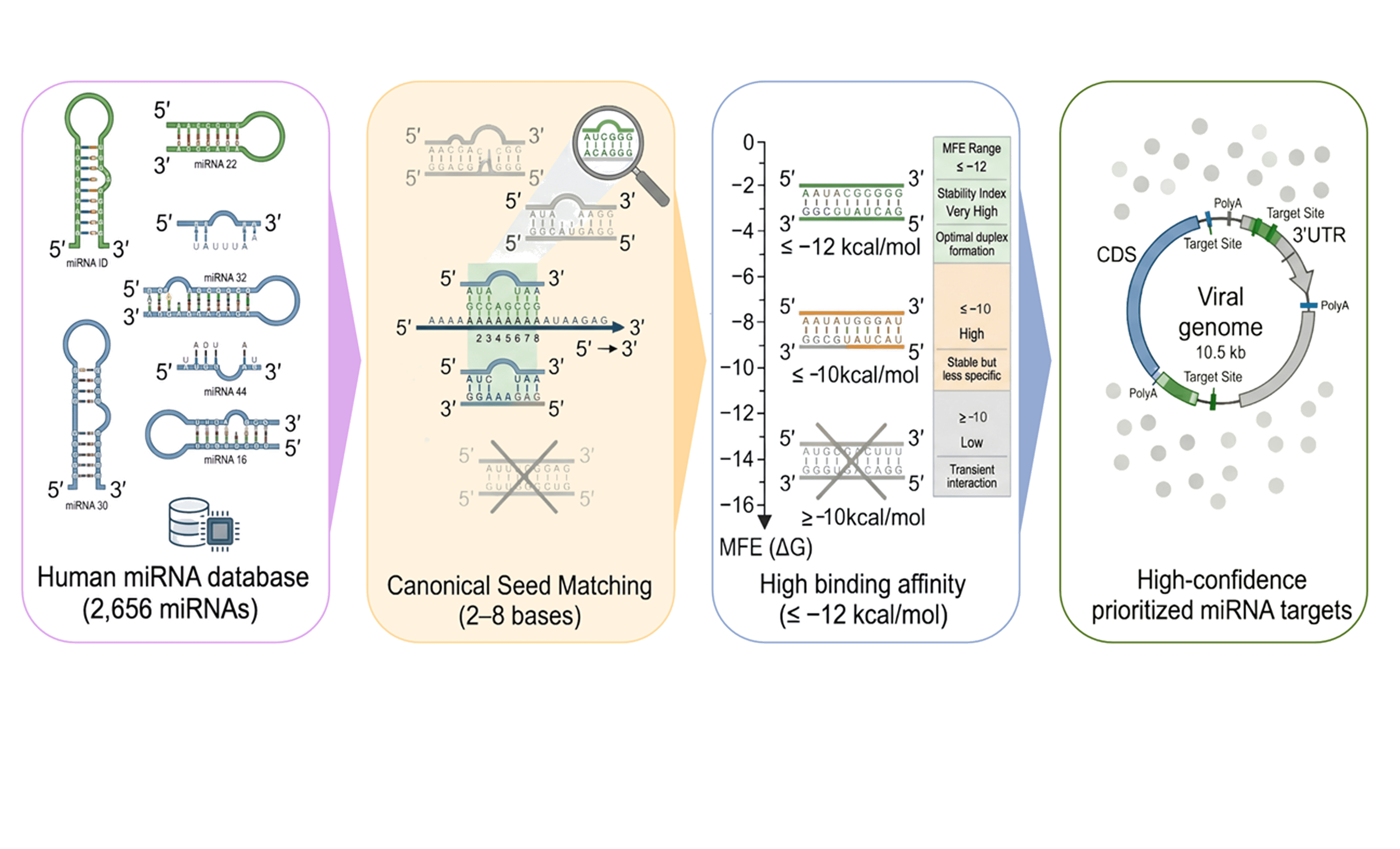
Every input passes through the same six-stage biological pipeline before a confidence grade is emitted.
Auto-detects DNA, RNA or protein. Protein inputs trigger a tblastn search to recover the source nucleotide region.
Boyer–Moore string matching locates every canonical or relaxed seed variant across the target at speed.
The 20 nt flanking each hit is scored for AU content, a proxy for structural accessibility.
RNAduplex computes the optimal secondary structure & minimum free energy of the miRNA–target duplex.
Competing seeds at the same locus are clustered and the optimal interaction wins on composite score.
Hits land in one of four tiers based on stringent thresholds across all four scoring axes.
Bug reports, feature requests, citation questions — drop the team a line directly.
Citation details pending publication — full BibTeX will appear here on release.